Clark County Contractor Referral Service
Bathroom Remodel in Vancouver, WA
Tell us about your bathroom and get connected with an independent local contractor.
A Plain Guide to Remodeling a Bathroom in Vancouver
A bathroom remodel in Vancouver usually starts with one problem that will not go away. A tub nobody uses, a fan that leaves the mirror fogged for an hour, soft flooring beside the toilet, or a layout that stopped fitting the household years ago. This page explains how the work goes here, what shapes the cost, and how to check a contractor before you sign anything.
Bathroom Remodel Vancouver is a referral service, not a contractor. You send a short request describing the room and what you want changed. We pass it to an independent local contractor who works in your part of Clark County. The contractor contacts you, looks at the bathroom, and gives you a written estimate under their own name.
Vancouver homes vary a lot from one side of town to the other. An older house near downtown can hide galvanized supply lines and plaster walls, while a newer home in east Vancouver more often has a builder-grade fiberglass tub surround that has reached the end of its life. Knowing which kind of house you have helps the contractor plan the visit and helps you ask better questions.
How This Referral Service Works
Bathroom Remodel Vancouver is a contractor referral service. We do not send crews, pull permits or sign remodeling contracts. Our part is to receive your request, check that it has enough detail to be useful, and pass it to an independent local contractor who takes on bathroom work in your area.
From there the contractor takes over. They call or email you, arrange a visit, measure the room, and write the estimate. The scope, the schedule, the payment terms and any warranty are set out in the contractor's own agreement with you. You are free to ask questions, compare it with other bids, or decline.
Sending a request does not commit you to hiring anyone. We still encourage every homeowner to look up the contractor with the Washington State Department of Labor & Industries before signing. The section on choosing a contractor further down this page explains what to check and why it matters.
Bathroom Remodel Services in Vancouver, WA
Requests cover the full range of bathroom work. That includes a Bathroom Remodel of any size, a Walk-In Shower, a Tub to Shower Conversion, Tub Installation, a Shower Remodel that keeps the footprint but replaces everything you see, and a Full Bathroom Remodel taken down to the studs. Each has its own page with detail on what the job involves.
Bathroom Remodel
How a bathroom remodel runs from first measurements to final walkthrough, and the scope decisions that move the cost most.
Bathroom Remodel →Walk-In Shower
Design decisions for a new walk-in shower: entry height, curbless feasibility, seating, glass and keeping water inside the shower.
Walk-In Shower →Tub to Shower Conversion
What it takes to turn a bathtub alcove into a shower: the drain move, valve changes, wall rebuild and what fits.
Tub to Shower Conversion →Tub Installation
Replacing or adding a bathtub: alcove, freestanding and soaking tubs, surrounds, drain orientation and whether the floor can carry it.
Tub Installation →Shower Remodel
Renovating a shower you already have: failing walls, worn bases and pans, old valves, tired enclosures and moisture you cannot see.
Shower Remodel →Full Bathroom Remodel
Whole-room bathroom renovation: demolition, layout changes, flooring, lighting, ventilation, vanities and the order the trades work in.
Full Bathroom Remodel →Where We Take Requests
Requests come from across Vancouver, from older streets in Hough and Uptown Village near downtown to Cascade Park and Fisher's Landing on the east side. The housing changes as you cross town, and so does the typical bathroom job, which is why the contractor always starts with a visit.
Outside the city limits, we take requests from Hazel Dell, Salmon Creek, Felida, Mount Vista, Minnehaha, Orchards, Five Corners, Brush Prairie and Hockinson. These are unincorporated communities, so permits there generally go through Clark County instead of the City of Vancouver.
We also pass along requests from the surrounding cities of Camas, Washougal, Battle Ground, Ridgefield, La Center and Woodland. Each of these towns has its own page on this site, with notes on the local housing and what to include in a request from there.
Why Start With Bathroom Remodel Vancouver
Matched by location
Your request goes to an independent contractor who takes bathroom work in your part of Clark County.
One clear request
Describe the room, the problem and what you want changed. A few clear details help the contractor arrive prepared.
Honest about who does the work
We are a referral service. The contractor gives the estimate, signs the agreement with you and is responsible for the work.
No obligation
Sending a request does not commit you to anything. You decide whether to accept the contractor's estimate after you have read it.
Verification you can do yourself
We explain how to look up any Washington contractor's registration, bond and insurance with L&I, so you are not taking anyone's word for it.
Written for this area
The guidance on this site reflects Vancouver's wet climate and its mix of older and newer homes, not generic remodeling tips.
What Happens During a Bathroom Remodel
The visit and the written scope
The contractor starts by looking at the room. They measure, check where the drain and supply lines run, look at the fan and the window, and ask how you use the space. In many Vancouver homes they will also look under the floor from the crawl space, because that shows the condition of the subfloor and pipes before anything is opened. What comes out of the visit is a written scope listing what is removed, what goes in, and who supplies fixtures and tile.
Demolition and what it reveals
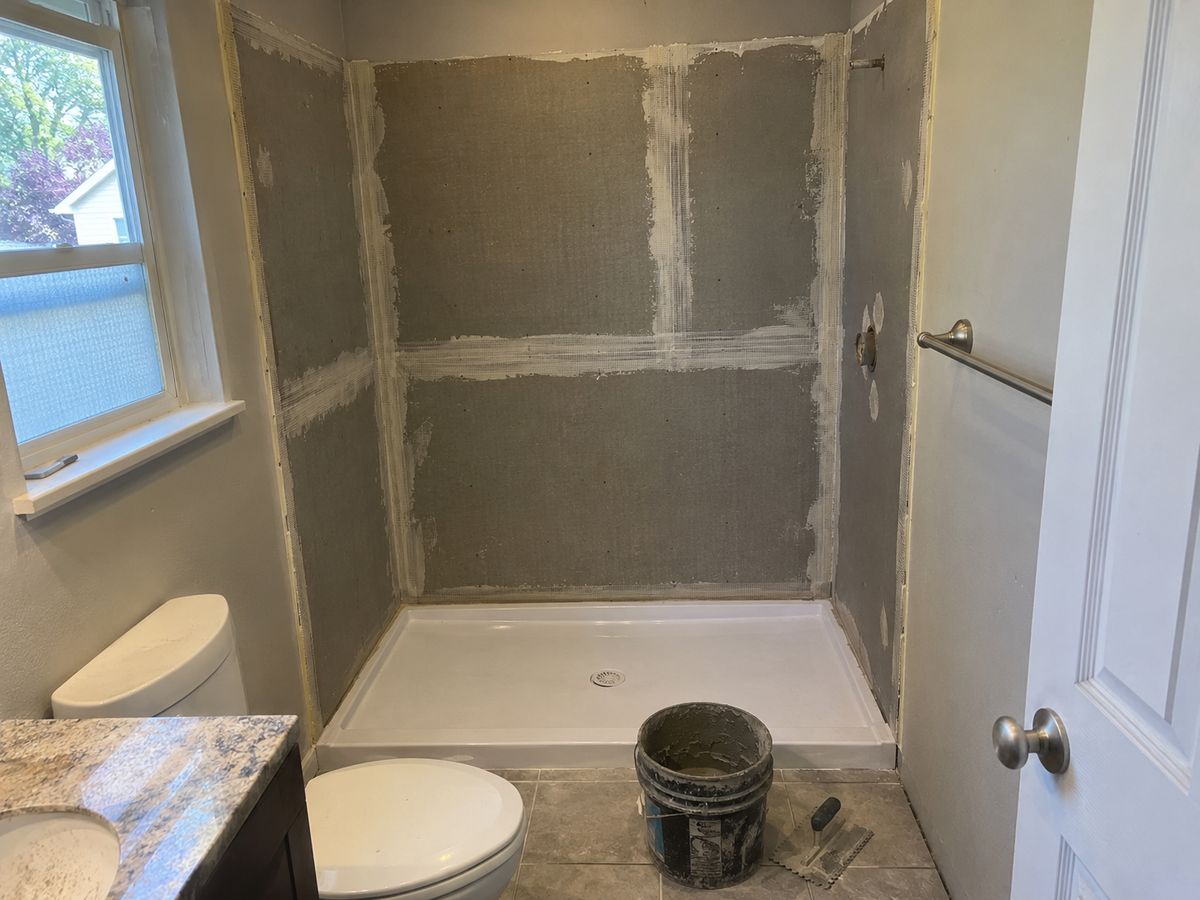
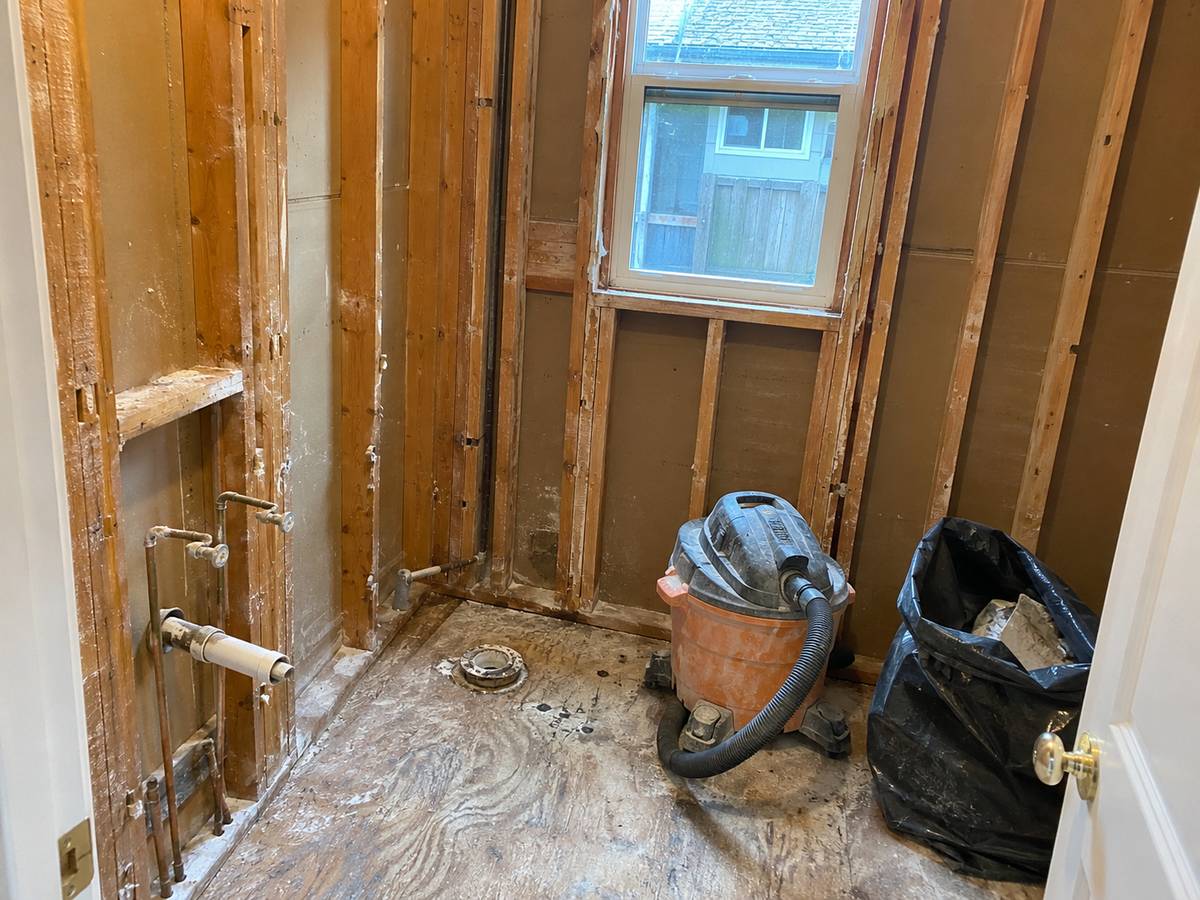
Demolition is short and loud. Old fixtures, wall surrounds and flooring come out, and the framing is exposed. This is the stage where surprises show up: a subfloor softened by a slow leak at the toilet, damp insulation behind a tub wall, or old piping that should not be closed back in. A careful contractor stops, shows you what they found, and prices the change in writing before going further.
Rough work, inspection and waterproofing
With the walls open, the plumber sets the new valve and drain, and the electrician runs circuits for the fan, lighting and outlets. Where a permit applies, an inspector checks this work before it is covered. Then the wet areas are built: backer board, a waterproofing membrane or pan, and sealed seams and corners. Everything that follows depends on this layer, so it is worth asking how it will be tested. Many contractors fill the shower pan with water and leave it to confirm it holds.
Finishes and the final walkthrough
Tile, flooring, paint, the vanity, the toilet and glass go in roughly in that order. Custom shower glass is often measured only after the tile is finished, which can leave a stretch of waiting near the end. At the walkthrough, run every fixture, check that the fan pulls air, look at caulk lines and tile edges, and write down anything unfinished. Agree on that list with the contractor before the final payment.
Signs It Is Time to Remodel Your Bathroom
Water is getting where it should not
Soft or spongy flooring near the tub or toilet, a stain on the ceiling below, caulk that turns black again weeks after you replace it, and loose or hollow-sounding tiles all point to moisture behind the surface. These problems do not stay the same size. A small leak in a shower wall can rot the framing over a few wet seasons, and the repair grows with it. If you see more than one of these signs, ask the contractor to check what is behind the wall, not only what covers it.
The room never dries out
In Vancouver's cool, damp months a bathroom with a weak fan can stay wet from one shower to the next. Peeling paint, a mirror that stays fogged, mildew on the ceiling and a musty smell in towels are the usual clues. Sometimes a new fan ducted to the outside is enough. When moisture has already damaged drywall or trim, the fix becomes part of a larger remodel.
The fixtures are worn out
Fiberglass surrounds crack and yellow. Enamel wears through on old steel tubs. Valves drip, drains slow down, and replacement parts get harder to find for older faucets. When several fixtures reach that point together, replacing them one at a time usually means more labor and disruption than doing the room once.
The layout no longer fits
A high tub wall becomes a daily risk for someone with a sore hip or poor balance. A single sink stops working when two people leave at the same hour. A hall bath shared by teenagers needs storage it never had. These are not emergencies, but they are good reasons to remodel, and they are easier to plan for when nothing is leaking. Before the contractor visits, write down what bothers you most about the room, in order of importance. That list keeps the scope honest when choices have to be made.
What Affects the Cost of a Bathroom Remodel in Vancouver
Size and scope
The biggest factor is how much of the room changes. Replacing fixtures and surfaces in the same positions is the simplest version. Taking the room to the studs, replacing the subfloor and rebuilding the shower costs more because more trades are involved for more days. A small hall bath and a large primary bath with a separate shower and tub are different jobs even with the same finishes.
Moving plumbing and walls
Keeping the toilet, tub and sink where they are saves money. Moving a drain means opening the floor, and in a house on a concrete slab it means cutting concrete. Homes with a crawl space, which are common around Vancouver, give the plumber easier access from below. Moving or removing a wall adds framing, electrical and drywall work, and sometimes engineering.
The age of the house
Older homes near downtown and in central Vancouver can hold galvanized steel supply lines, cast iron drains, ungrounded wiring and walls that are far from square. Bringing what is exposed up to current code is part of the job, and it adds labor that a newer house in east Vancouver may not need. Homes built before 1978 may also have lead paint, which calls for specific work practices when painted surfaces are disturbed.
Materials, permits and tax
Tile is where budgets move most. Large simple tile goes in faster than small mosaics or patterns with many cuts, so labor changes along with the material. Custom glass, stone tops and wall-mounted fixtures all cost more than standard versions. Permit fees depend on the scope and on whether the home is inside Vancouver city limits or in unincorporated Clark County. Washington also applies sales tax to remodeling labor as well as materials, so ask whether the estimate includes it. People who have moved over from Oregon are sometimes surprised by that line. A contingency for hidden damage is worth discussing before work starts, not after the floor is open.
How Vancouver's Climate and Housing Shape the Work
A long wet season
Vancouver gets months of cool, damp weather each year, and outdoor air does little to dry a house during that stretch. A bathroom adds steam on top. That is why ventilation deserves real attention here. Ask for a fan sized for the room and ducted all the way to the outside through a wall or roof cap, never into the attic or crawl space. A quiet fan on a timer or humidity control gets used, and a loud one gets switched off.
Waterproofing behind the tile
Tile and grout are not waterproof. The layer behind them is what keeps water out of the framing. A properly built shower has a continuous membrane or pan system, sealed at corners, niches, benches and the valve opening, with the floor sloped to the drain. In a damp climate, framing that gets wet dries slowly, so small failures turn into rot sooner than they would somewhere dry. Ask which system the contractor uses and whether it will be flood tested.
Crawl spaces and exterior walls
Many homes in Clark County sit over a crawl space. A slow leak at a toilet flange or tub drain can drip there for years without being seen, so it is worth having the contractor look underneath at the first visit. Bathrooms on an exterior wall bring their own issue. Cold surfaces collect condensation, so insulation matters when that wall is open, and so does a window that seals well.
Older homes and newer homes
Near downtown, in neighborhoods such as Hough, houses can be many decades old, with small bathrooms, plaster walls, and plumbing from several eras joined together. Mid-century ranch homes in central Vancouver often have a compact hall bath with the tub set against an outside wall. Subdivisions on the east side, around Cascade Park and Fisher's Landing, are newer and more standard in layout, but their original fans, surrounds and vinyl floors are now old enough to fail. Each type calls for a different plan.
How to Choose and Verify a Contractor in Washington
Start with L&I
In Washington, construction contractors must register with the Washington State Department of Labor & Industries, usually called L&I. Registration requires the contractor to carry a bond and liability insurance. L&I runs a public lookup tool on its website where you can search by business name or registration number. It shows whether the registration is active, the bond and insurance on file, and the status of workers' compensation coverage. Checking takes a few minutes and should happen before you sign, with every contractor, including one referred through this site.
Know who does the plumbing and electrical
A general contractor registration does not by itself cover plumbing or electrical work. Those trades have their own credentials in Washington, and the people doing that work should hold them. Ask who the plumber and electrician will be and whether they are employees or subcontractors. You can look those businesses up in the same L&I tool.
Read the estimate closely
A useful estimate names what is being removed and installed, the waterproofing system, who buys the fixtures and tile, who obtains the permits, and what happens if hidden damage is found. It should set out a payment schedule tied to stages of work, not a large sum up front. Compare estimates by scope first and total second. Two figures that look far apart often describe two different jobs.
Ask practical questions
Ask how many jobs the contractor has under way at once, who will be on site each day, how dust is contained, and how long the room will be out of use. Ask for contacts of recent bathroom customers in Clark County and follow up with them. Ask what warranty they give on labor and get it in writing. Washington also requires contractors to give homeowners a written disclosure notice on many residential jobs, which explains lien rights and the bond. If a contractor avoids any of these questions, treat that as information.
Designing the Bathroom for Your Household
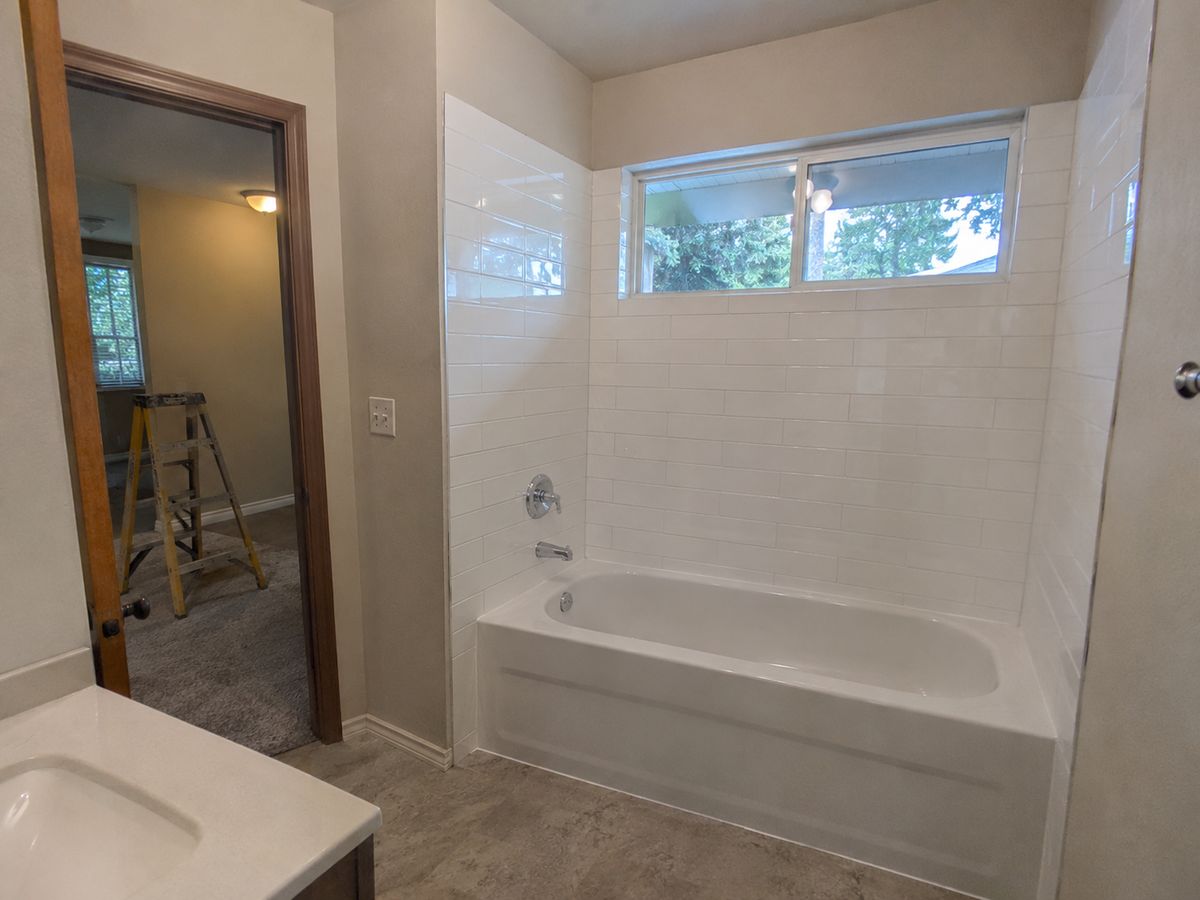
Decide who the room is for
A hall bath used by children needs a tub, tough surfaces and storage at their height. A primary bath for two adults may be better served by a larger shower and two sinks. A guest bath can be simple. Before choosing tile, write down who uses the room, at what times, and what gets in their way now. That list should drive the layout.
Tub, shower or both
Many households stop using the tub and want a walk-in shower in its place. That works well in a primary bath. In a house with only one bathroom, think about keeping a tub, since families with small children look for one and it may matter when you sell. If the home has a second bathroom, converting one and keeping a tub in the other is a common answer.
Plan for the years ahead
If you expect to stay in the house, small choices now can save a second remodel later. A low or curbless shower entry, a bench, a handheld shower head on a slide bar, a comfort-height toilet and lever handles help everyone, not only older adults. Ask the contractor to add solid blocking inside the walls where grab bars could go, even if you do not want bars yet. It adds little work while the walls are open. A wider doorway is worth asking about if anyone may need a walker or wheelchair.
Storage, light and upkeep
Most complaints about finished bathrooms are about storage and cleaning. A recessed niche in the shower, drawers in place of vanity doors, and a medicine cabinet set into the wall add room without taking floor space. Good light at the mirror comes from the sides or from a lit mirror, not only from overhead. For upkeep, larger tile means fewer grout lines, and a slip-resistant floor tile matters more than its color. In this damp climate, choose materials that tolerate moisture and a paint made for bathrooms.
How Your Request Works
- Tell us about the projectSend the form or call with what you want to change and where the home is.
- We pass it to a local contractorYour request goes to an independent contractor who works in your area.
- The contractor contacts youThey look at the job, answer your questions and give you their own estimate. You decide whether to go ahead.
Bathroom Remodel Questions in Vancouver
Does Bathroom Remodel Vancouver do the remodeling work?
No. We are a referral service. We receive your request and pass it to an independent local contractor, who contacts you, visits the home, and gives you an estimate. The contractor does the work under their own agreement with you.
Do I need a permit for a bathroom remodel in Vancouver, WA?
Often, yes. Replacing surfaces alone may not need one, but new or moved plumbing, new electrical circuits, and changes to walls usually do. Inside city limits the City of Vancouver handles permits, and unincorporated areas go through Clark County. The contractor should confirm what applies.
How long will my bathroom be out of use?
It depends on the scope, the condition of what is behind the walls, inspection scheduling, and lead times for tile, vanities and custom glass. Ask the contractor for a written schedule and for the points where the job could be held up.
How do I check a contractor in Washington?
Use the contractor lookup on the Washington State Department of Labor & Industries website. It shows whether the registration is active and the bond and insurance on file. Do this before signing, for any contractor, including one you meet through this service.
What should I include in my request?
Give the part of town, the rough age of the house, which bathroom it is, what is wrong with it now, and what you want changed. Mention any signs of leaks or soft flooring, and say whether you have a second bathroom to use during the work.
Call for a Free Estimate
Describe your bathroom and what you want changed, and we will pass your request to an independent local contractor.